Source-backed analysis9
Review basis
Research-based review: the AppDuo Editorial Team compiled it from official pages, documentation, app stores, press and user feedback, without hands-on testing. Every claim links to a source with the date it was checked.
9 reference sourcesInformation updated Nov 10, 2026
How we review
OpenAI Codex Review
OpenAI's coding agent across an open-source CLI, desktop app, cloud and mobile
By AppDuo Editorial Team · Updated
- macOS
- Windows
- Linux
- Web
- iOS
- Android
- API
On this page
Decide at a glance
Our verdict
Codex suits people already on ChatGPT who want one coding agent across the terminal, IDE, cloud and phone, with an Apache-2.0 open-source CLI. The trade-offs are access bundled into ChatGPT plans with estimated rather than fixed limits, OpenAI-only models, and individual-plan data that may be used for training unless you opt out.
Best for: ChatGPT Plus or Pro subscribers who want a coding agent without buying a separate service
Skip it if: Anyone who wants to pick models from several vendors in one tool
Pros
- One account covers the desktop app, web, CLI, IDE extension and ChatGPT on iOS and Android
- Apache-2.0 open-source CLI installable via npm, Homebrew or script on macOS, Linux and Windows
- Default sandbox with no network and writes limited to the workspace, plus approval modes from read-only to full access
Cons
- Limits are expressed as estimated messages per 5 hours with possible weekly caps; cloud tasks use more than local messages
- Pro has three price tiers (100, 200 or 500 USD a month), which complicates choosing
All pros and cons · Who is it for?
Pros
- Free and Go (8 USD a month) tiers to get started; Business from 20 USD per user per month billed annually
Cons
- Per Wikipedia, a vulnerability (since patched) in March 2026 let malicious GitHub branch names inject commands and retrieve authentication tokens
Best for
- Terminal-oriented developers who want an open-source tool with a default sandbox
- Teams that want cloud agents, automatic pull request review, SSO and central admin
Skip it if
- Anyone who needs a fixed cost and a known number of requests per month
Problems it solves
Experience & key features
What is Codex?
Codex is OpenAI's coding agent for writing code, fixing bugs and reviewing changes. Per Wikipedia it launched in April 2025 as Codex CLI, an open-source terminal tool, followed by a cloud version powered by the codex-1 model in research preview on 16 May 2025. Today Codex comes as a desktop app, web, CLI, IDE extension and a mobile version inside the ChatGPT app, all tied to one ChatGPT account. Per Wikipedia, OpenAI merged the Codex app into the ChatGPT desktop app on 9 July 2026.
How it works and key features
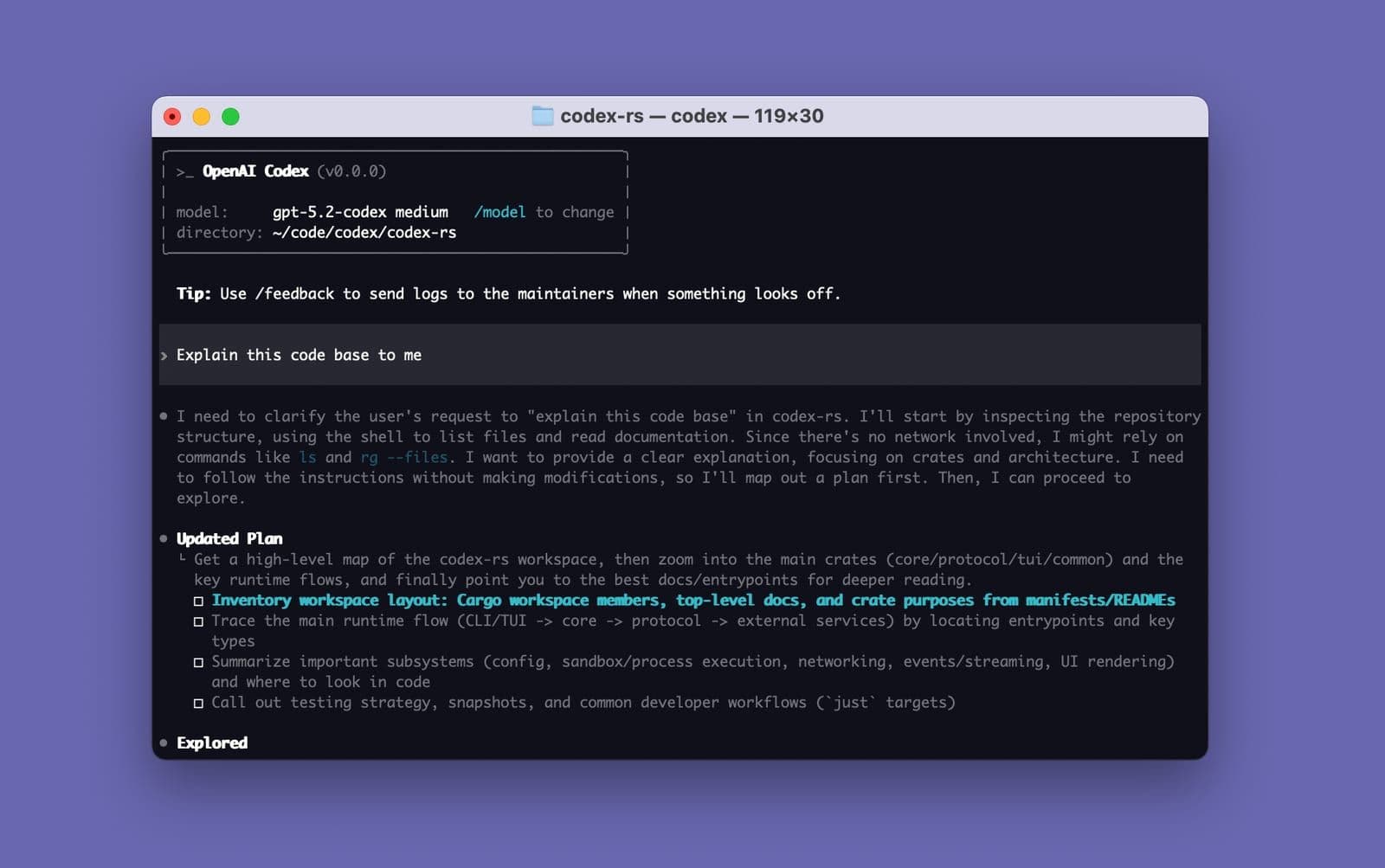
According to the homepage, Codex runs many agents in parallel, uses computer and browser tools to verify work, and keeps going in the cloud after you close your laptop. Each repo gets reusable cloud environments, and Codex automatically reviews pull requests. Plugins connect it to other tools. Locally, the CLI and IDE extension run in a sandbox: no network and writes limited to the workspace by default; Auto mode asks before editing outside it or using the network, while full-access mode (--yolo) disables both sandbox and approvals and is not recommended in the docs. In May 2026, The Decoder reported that a phone can monitor, approve changes and start new tasks for Codex through an encrypted relay.
Pricing and value
Codex is bundled with ChatGPT plans. Per the official pricing page: Free and Go (8 USD a month) use GPT-6 Luna in the desktop app; Plus at 20 USD a month adds web, CLI, IDE, iOS, automatic code review and Slack; Pro starts at 100 USD a month (tiers of 100, 200 and 500 USD); Business is 20 USD per user per month billed annually or 25 USD monthly; Enterprise is quoted by sales. Using an API key means paying API prices without cloud features. Plus limits are estimates, for example 15 to 160 local messages per 5 hours with GPT-6.1 Sol, with weekly caps possible. Opened from Vietnam, the homepage showed Plus at 522,500 VND a month, Pro at 2,849,000 VND a month and Business at 519,000 VND per user per month (billed annually, 2+ seats).
More analysis
Who it's for and how it compares
Codex suits people already inside the ChatGPT ecosystem who want one coding agent across terminal, IDE, cloud and phone. Anthropic's Claude Code and Cursor are the closest rivals; Cursor lets you choose models from several vendors and is a full editor, while Codex uses OpenAI models only. GitHub Copilot, Google Antigravity and Windsurf also compete here. Per Wikipedia, Reuters reported that pressure from Claude Code led OpenAI to redirect resources to Codex, so the field is still moving quickly.
Screenshots

Plans & pricing
Prices last verified Nov 10, 2026
Free
PersonalFree
GPT-6 Luna at Standard speed in the desktop app, subject to rollout. The pricing page gives no numeric usage limit.
Go
Personal$8/mo
8 USD a month. The same GPT-6 Luna at Standard speed in the desktop app as Free, subject to rollout.
Plus
Personal$20/mo
20 USD a month. Codex on the web, CLI, IDE extension and iOS; cloud integrations such as automatic code review and Slack; GPT-6.1 Sol and GPT-6 Luna; extra usage through ChatGPT credits. Estimated 15 to 160 local messages per 5 hours with GPT-6.1 Sol.
Pro
Personal$100/mo
From 100 USD a month (tiers of 100, 200 or 500 USD). Everything in Plus; currently no five-hour limit; Ultrafast mode on the 500 USD tier.
Business
Business$25/mo/user
$20/mo billed yearly
20 USD per user per month billed annually (2+ seats), 25 USD billed monthly. Codex and ChatGPT on desktop and mobile, larger cloud VMs, ChatGPT credits, SAML SSO and MFA.
Enterprise & Edu
BusinessContact sales
Contact sales. Adds priority processing, SCIM, EKM, RBAC, Compliance API and retention and residency controls.
- Free plan limits
- The Free plan offers only GPT-6 Luna at Standard speed in the desktop app, aimed at quick coding tasks, with no image generation. Codex can also run with an API key at separate API prices, without cloud features such as GitHub code review or Slack.
- Free trial
- No free trial
Cancellation & refunds
The pages opened state no refund policy for Codex plans.
Privacy
Per OpenAI's help center, on individual plans (Free, Plus, Pro) your content may be used to train models; to opt out, switch off Improve the model for everyone under Settings > Data controls in ChatGPT, or choose Do not train on my content in the Privacy Portal. Codex also has a separate Include environments setting for training on full environments, which those two options do not change. If you submit feedback (a thumbs up or down), the whole related conversation may be used for training even after opting out. For ChatGPT Business, Enterprise, Edu and the API, OpenAI says it does not use inputs or outputs to improve models by default. Technically, the documentation says the Codex CLI and IDE extension default to no network access and write permission limited to the active workspace, while cloud tasks run in isolated OpenAI-managed containers whose agent phase is offline by default. The pages opened do not state data retention periods.
OpenAI Codex alternatives
 7.5/10
GitHub Copilot
An AI coding assistant that runs in most major IDEs and ties into GitHub
 7.4/10
Claude Code
Anthropic's coding agent across terminal, IDE, web and CI
Frequently asked questions
Is Codex free?
There is a Free plan with GPT-6 Luna at Standard speed in the desktop app, subject to rollout; the pricing page gives no numeric limit. The CLI is open source but needs a ChatGPT sign-in or an API key billed at API prices.
Which operating systems does Codex support?
The Codex CLI runs on macOS (Apple Silicon and x86_64), Linux (x86_64 and arm64) and Windows via PowerShell. Per Wikipedia, the desktop app is available for Windows and macOS, with the Windows version arriving in March 2026. There is also web, plus iOS and Android through the ChatGPT app.
Does Codex train on my code?
On individual plans (Free, Plus, Pro) it may, unless you turn off Improve the model for everyone or choose Do not train on my content; Codex also has a separate Include environments setting. For Business, Enterprise, Edu and the API, OpenAI says it does not train on content by default.
Can Codex use models from other vendors?
The pages opened list only OpenAI models (such as GPT-6.1 Sol and GPT-6 Luna) in ChatGPT plans; no option to use another vendor's models appeared.
Review evidence & sources9
Scores
- Ease of use
- 7.6
- Features
- 8.5
- Value for money
- 7.4
- Performance
- 7.2
- Support
- 6.5
- Privacy & security
- 6.8
Why this score
Install takes one command (npm, Homebrew or script) or an app download, with sign-in through a ChatGPT account. Marked down because many surfaces, plans, models and approval modes take time to learn. The interface is English-only.
Why this score
Parallel agents, reusable cloud environments per repo, automatic pull request review, plugins, a CLI, IDE extension, desktop and mobile. Wikipedia reports over 2 million weekly active users by mid-March 2026 and OpenAI said more than 4 million weekly in May 2026. Not scored higher because only OpenAI models are offered and the sources opened contain no solid independent comparison.
Why this score
Included in ChatGPT plans from 8 USD (Go) and 20 USD (Plus), with Business at 20 to 25 USD per user, which is good value if you already use ChatGPT. Estimated limits and Pro tiers up to 500 USD make costs harder to predict.
Why this score
The pricing page estimates 15 to 160 messages per 5 hours for GPT-6.1 Sol on Plus, and OpenAI says Codex works efficiently with fewer tokens. These are vendor figures; no independent measurements appeared in the sources opened, so the score is cautious.
Why this score
Official documentation, a public GitHub repository with about 134,700 stars and the OpenAI help center. The pages opened show no dedicated human support channel for Codex on individual plans and no independent support ratings on Trustpilot or G2, so the score sits level with peers such as Claude Code and Cursor.
Why this score
On individual plans content may be used for training by default and must be switched off, Codex has its own Include environments setting, and feedback can still send a whole conversation to training. The March 2026 token-exposure vulnerability also counts against it. In its favour, Business, Enterprise, Edu and API are not trained on by default and the sandbox has no network by default.
What users say
- App Store (United States), ChatGPT app, which hosts Codex on iPhone4.8/5 · 12,000,000
Sources
- Vendor-providedOfficial Codex page (openai.com)Nov 10, 2026
- Vendor-providedOfficial Codex page (chatgpt.com)Nov 10, 2026
- Vendor-providedOfficial Codex pricing documentationNov 10, 2026
- Vendor-providedOfficial documentation: agent approvals and securityNov 10, 2026
- Vendor-providedOpenAI Help Center: how your data is used to improve model performanceNov 10, 2026
- Vendor-providedGitHub: openai/codex (CLI repository)Nov 10, 2026
- storeApp Store listing: ChatGPT (US)Nov 10, 2026
- pressThe Decoder: Codex on iOS and Android (2026-05-15)Nov 10, 2026
- Community-reportedWikipedia: OpenAI Codex (AI agent)Nov 10, 2026
Specs & compatibility
- Developer
- OpenAI
- Headquarters
- United States
- Launched
- 2025
- Category
- Development
Capabilities
- AI features
- Public API
- Open source
- Integrations
- Mobile app
Platforms
- macOS
- Windows
- Linux
- Web
- iOS
- Android
- API
Interface languages
- English
Integrations
- GitHub
- Slack
- ChatGPT
- VS Code and other IDEs (extension)
- Plugins
Support
- Help center
- Community forum
Change history
- Company.Per Wikipedia, OpenAI merges the Codex app with the ChatGPT desktop app.
- Feature.Codex arrives in the ChatGPT app on iOS and Android (preview, all plans including Free); OpenAI says more than four million people use Codex weekly.
- Feature.The Windows version of the app arrives with native PowerShell support; the same month a branch-name command-injection vulnerability was reported and patched, per Wikipedia.
Full change history (6)
- Feature.Per Reuters, as cited by Wikipedia, the Codex desktop app launches to manage multiple coding agents.
- Feature.OpenAI announces a research preview of Codex in the cloud, powered by codex-1, a version of o3 optimised for software engineering.
- Launch.OpenAI releases Codex CLI, an open-source coding agent that runs in the terminal.
About the author
Reviews & comments
Written by readers with a verified email address.
No reviews yet. Have you used OpenAI Codex? Share your real experience.
Reader reviews are counted separately and do not affect the Editorial Team’s score.
No comments yet. Be the first to share your experience.
Comments are readers’ opinions, not content from the AppDuo Editorial Team.