Source-backed analysis13
Review basis
The AppDuo team prepared this review by analysing product features, official documentation and user feedback to help you understand its strengths, limitations and suitability for your needs.
13 reference sourcesInformation updated Nov 10, 2026
How we review
By AppDuo Editorial Team · Updated
- Web
- iOS
- Android
On this page
Decide at a glance
Our verdict
AWS suits companies and engineering teams that need broad service coverage, many Regions (39 Regions and 124 Availability Zones per the official page) and pay-as-you-go billing. The trade-offs: bills are hard to predict, the console and service catalogue are complex, and major incidents such as the roughly 14.5-hour US-EAST-1 outage in October 2025 show the risk of depending on one provider.
Best for: Companies and startups needing one cloud broad enough to run everything from web apps to AI, data and infrastructure
Skip it if: Small solo projects that want simple hosting at a fixed price, where simpler platforms such as DigitalOcean or Vercel are easier
Pros
- Global infrastructure: 124 Availability Zones in 39 Regions, with Saudi Arabia and Chile Regions announced
- Pay-as-you-go with no long-term contracts, plus Savings Plans for those who commit for 1 or 3 years
- Customers own their content and choose Regions and encryption keys; AWS says it does not use content for advertising
Cons
- Usage-based pricing is hard to forecast; the customer agreement has no refund provision and charges 1.5% monthly interest on late payments
- Major incidents have occurred: S3 on 28 Feb 2017 and US-EAST-1 on 19–20 Oct 2025, lasting about 14.5 hours and affecting many dependent services
All pros and cons · Who is it for?
Pros
- A Free plan with up to $200 in credits; 30+ services free within monthly limits
- A broad AI ecosystem with Amazon Bedrock, offering foundation models through a single API
Cons
- The service catalogue is vast and hard to learn; paid support is a percentage of your bill, from $29 per account per month
Best for
- Teams with infrastructure engineers who want fine-grained control over data location, encryption and access
- People who want to try the cloud with up to $200 in free credits before committing
Skip it if
- Teams without someone to keep watching permissions, budgets and architecture, since the catalogue and billing need ongoing attention
Experience & key features
What is AWS?
Amazon Web Services is Amazon's cloud computing platform. Per Wikipedia, its first infrastructure service, SQS, launched in beta in November 2004; Amazon S3 launched on 14 March 2006, followed by EC2 in August 2006. The first re:Invent conference was held on 27 November 2012, and Bedrock, a foundation-model service, became generally available in September 2023. On 14 May 2024 AWS announced Matt Garman as CEO, succeeding Adam Selipsky. Wikipedia reports 2025 AWS sales of $128.7 billion and operating income of $45.6 billion.
Key features
The about page calls AWS the "most comprehensive and broadly adopted" cloud, with millions of customers from startups to government agencies, though it gives no service count. Infrastructure spans 124 Availability Zones in 39 Regions, with Regions in Saudi Arabia and Chile announced. AI is a recent focus, with Amazon Bedrock for inference and building agents and Bedrock AgentCore for agents at scale. Customers manage access with IAM, Organizations and CloudTrail.
Pricing and value
AWS bills by usage with no long-term contracts; Savings Plans lower compute prices in exchange for an hourly spend commitment over 1 or 3 years. Newcomers can pick the Free plan with up to $200 in credits over 6 months, or the Paid plan with access to all services. One example price on the page: S3 storage at $0.023 per GB per month for the first 50 TB. Paid support includes Business Support+ from $29 per month and Enterprise Support from $5,000 per month. The customer agreement has no refund provision, so budget alerts and the pricing calculator are worth using before deploying.
More analysis
Who it's for and how it compares
AWS suits engineering teams that need broad service and Region coverage. Microsoft Azure is common in Microsoft-centric enterprises and Google Cloud is strong in data and Kubernetes; DigitalOcean, Vercel or Cloudflare Workers are simpler for small projects. Regional providers such as FPT Cloud are another option for those who prefer a local vendor. In the 2025 Stack Overflow survey, 43.3% of respondents used AWS.
Screenshots
Plans & pricing
Prices last verified Nov 10, 2026
Free plan
Free
Per the AWS Free page: up to $200 in credits ($100 on sign-up, up to $100 more by exploring key services), limited to select services. The account closes on its own after 6 months or when credits run out, whichever comes first, and you are not charged unless you convert to the Paid plan.
Paid plan (pay-as-you-go)
Contact sales
Access to all AWS services, billed by usage with no long-term contracts. New customers also get up to $200 in credits. Savings Plans (1- or 3-year commitment) lower compute prices. Support plans: Basic is free, Business Support+ starts at $29 per account per month and Enterprise Support at $5,000 per month.
- Free plan limits
- The AWS Free plan runs on up to $200 in credits over 6 months; 30+ services are free within monthly limits on both plans, though the page does not list the individual limits. The Free plan cannot scale beyond its credits.
- Free trial
- 180-day free trial · no credit card
Cancellation & refunds
The AWS Customer Agreement (updated 29 Oct 2026) contains no refund provision; fees incurred during a suspension or up to the termination date remain payable. AWS must give at least 30 days' notice before raising fees for services you already use.
Privacy
AWS's data privacy page says customers own their content, choose the Region where it is stored, and that AWS will not move or replicate it outside those Regions except as needed to provide services or comply with law. Encryption is available in transit and at rest, and customers can keep their own keys via KMS. AWS says it does not use customer content for marketing or advertising, discloses it only when legally required and redirects requests to the customer where possible. It cites ISO 27018 compliance and a SOC 2 Type II report. For GDPR, AWS publishes a GDPR Data Processing Addendum, and the Standard Contractual Clauses for transfers sit in the Service Terms and apply automatically. The Customer Agreement says AWS may use your content only to provide the services. A minor gap: the data privacy page carries no last-updated date.
Amazon Web Services alternatives
 7.8/10
DigitalOcean
Simple cloud with transparent pricing for developers and small teams
 7.5/10
Microsoft Azure
Microsoft's broad cloud platform, a natural fit for Microsoft-centric organizations
Frequently asked questions
Is AWS free?
There is a Free plan with up to $200 in credits; the account closes after 6 months or when credits run out, and you are not charged unless you convert to the Paid plan. 30+ services are free within monthly limits.
How does AWS charge?
By usage of each service, with no long-term contracts. Savings Plans (1- or 3-year commitment) reduce compute prices, and the AWS Pricing Calculator estimates your monthly bill.
How many Regions does AWS have?
The global infrastructure page lists 124 Availability Zones in 39 Regions, with 7 more Availability Zones and 2 more Regions (Saudi Arabia and Chile) planned. The page gives no explicit as-of date.
Does AWS use my data for advertising?
No. According to its data privacy page, AWS does not use customer content, or information derived from it, for marketing or advertising, and customers own their content.
Review evidence & sources13
Scores
- Ease of use
- 6.2
- Features
- 9.4
- Value for money
- 7.2
- Performance
- 8.0
- Support
- 7.0
- Privacy & security
- 8.0
Why this score
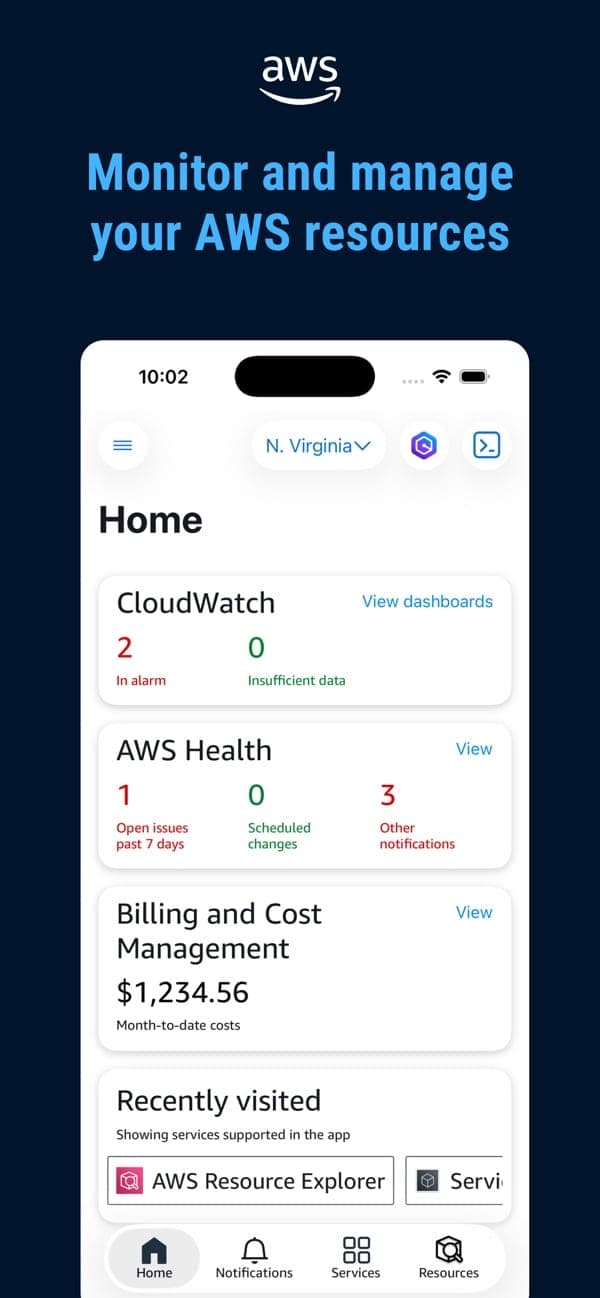
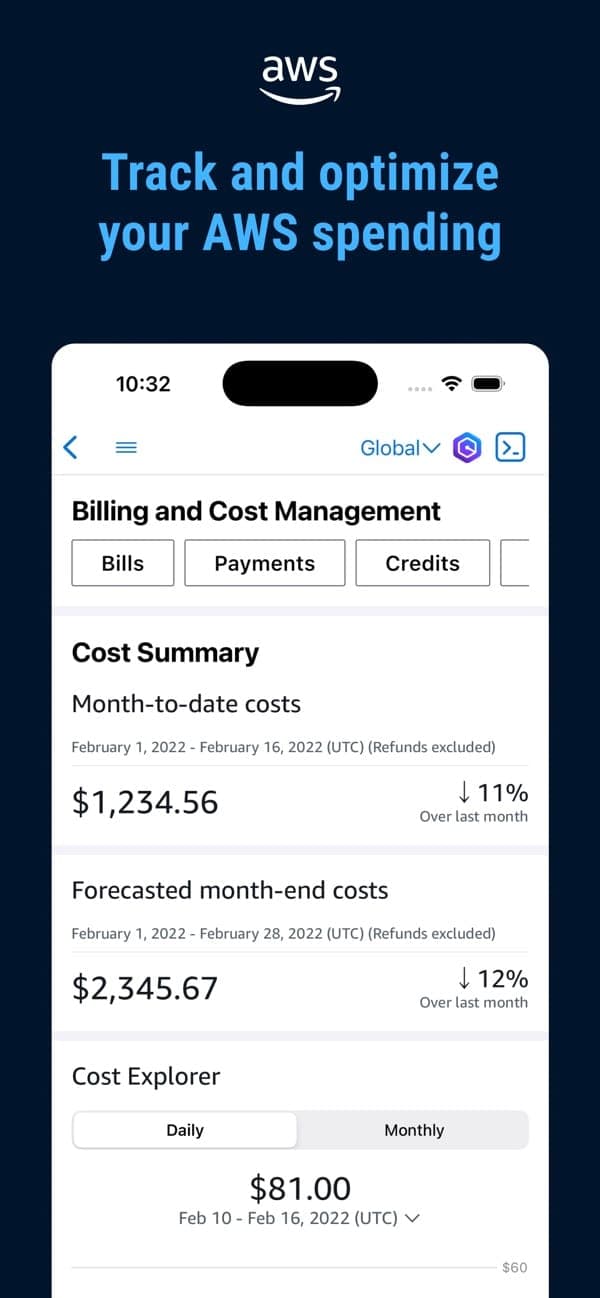
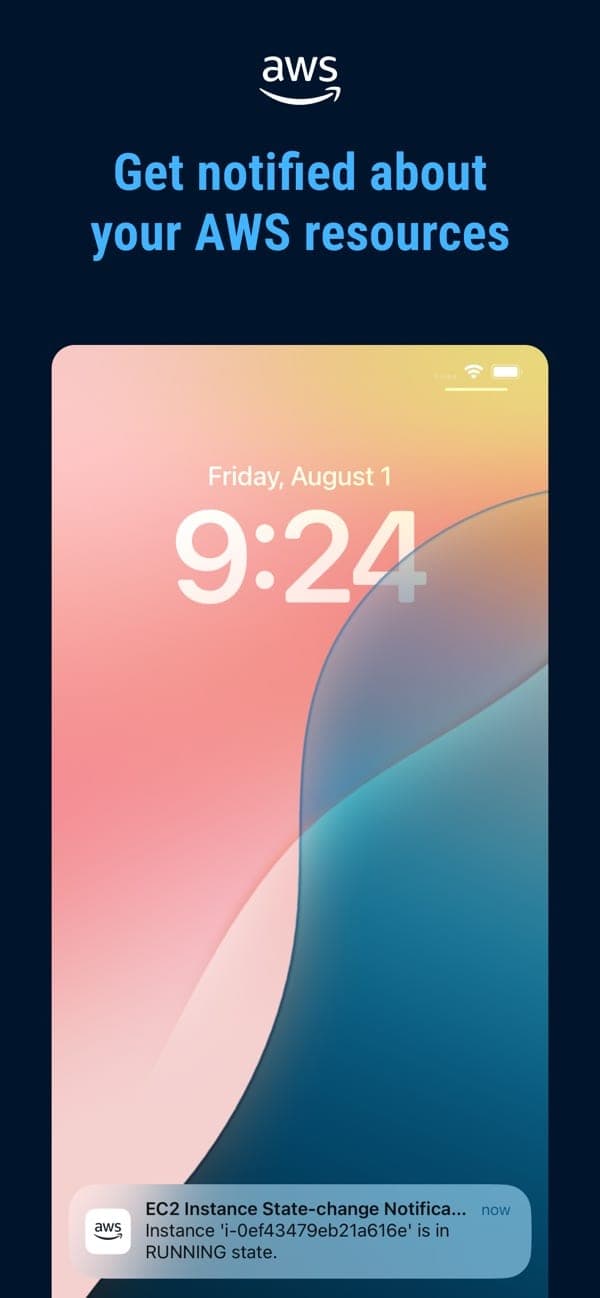
There is an AWS Console mobile app (4.7/5 from 6,187 ratings on the US App Store) and broad docs, but it only manages a select set of resources. The huge catalogue is hard for newcomers, and pricing needs a calculator to estimate bills. The interface is English-only.
Why this score
The largest cloud provider: the official page cites 124 Availability Zones in 39 Regions, with compute, storage, databases and AI (Bedrock). Wikipedia reports a 31% share in Q1 2023 per Synergy, ahead of Azure (25%) and Google Cloud (11%).
Why this score
Pay-as-you-go, Savings Plans and up to $200 in credits for newcomers. Marked down because costs are hard to predict, the agreement has no refunds, and paid support adds to the bill.
Why this score
Very broad global infrastructure, but documented major incidents: S3 in 2017 (recovered in about 5 hours per Wikipedia) and US-EAST-1 in October 2025 lasting about 14.5 hours per AWS's own post-event summary, caused by a race condition in DynamoDB's DNS management. A recent, long and wide-reaching outage keeps the score from going above 8.
Why this score
Basic is free, Business Support+ starts at $29 per account per month, Enterprise Support at $5,000 per month and Unified Operations at $50,000 per month; per-service SLAs are published separately. The support pricing page gives no specific response times, so the score is cautious.
Why this score
Customers own their content, pick Regions and can control encryption keys; AWS does not use content for marketing and cites ISO 27018, SOC 2 Type II, a GDPR DPA and automatically applied SCCs. Held below the top because much of the protection depends on the customer's own configuration (Regions, keys), and the data privacy page has no update date.
What users say
- App Store (United States), AWS Console app4.7/5 · 6,187
Sources
- Vendor-providedAWS Free Tier pageNov 10, 2026
- Vendor-providedAWS pricing overviewNov 10, 2026
- Vendor-providedAWS global infrastructure: Regions and Availability ZonesNov 10, 2026
- Vendor-providedAWS Data Privacy FAQNov 10, 2026
- Vendor-providedAWS GDPR CenterNov 10, 2026
- Vendor-providedAWS Customer AgreementNov 10, 2026
- Vendor-providedAWS Support plan pricingNov 10, 2026
- Vendor-providedWhat is AWS?Nov 10, 2026
- Vendor-providedAWS post-event summary: US-EAST-1 (Oct 2025)Nov 10, 2026
- storeApp Store listing: AWS Console (United States)Nov 10, 2026
- storeiTunes Lookup API: AWS Console appNov 10, 2026
- Community-reportedWikipedia: Amazon Web ServicesNov 10, 2026
- pressStack Overflow Developer Survey 2025: TechnologyNov 10, 2026
Specs & compatibility
- Developer
- Amazon Web Services, Inc.
- Headquarters
- United States
- Launched
- 2006
- Category
- Development
Capabilities
- AI features
- Integrations
- Mobile app
Platforms
- Web
- iOS
- Android
Interface languages
- English
Integrations
- Amazon Bedrock
- Amazon S3
- Amazon EC2
- AWS Lambda
- Amazon Aurora
- AWS Marketplace
Support
- Help center
Change history
- Update.A US-EAST-1 outage of about 14.5 hours (19–20 Oct 2025), caused by a race condition in DynamoDB's DNS management system, per AWS's post-event summary.
- Company.AWS announces Matt Garman as CEO, succeeding Adam Selipsky.
- Feature.AWS announces general availability of Amazon Bedrock, a managed foundation-model service behind a single API.
Full change history (7)
- Update.Major S3 outage in the Northern Virginia region caused by human error during debugging; full recovery after about five hours.
- Update.AWS holds its first re:Invent conference in Las Vegas with over 150 sessions.
- Launch.Amazon S3 launches as the first generally available AWS IaaS service; EC2 follows in August 2006.
- Launch.AWS's first infrastructure service, Simple Queue Service (SQS), launches in beta.